Benjamin Franklin's magic square explained
Benjamin Franklin's 8x8 magic square is famous for what it does beyond the basics. Every row and column adds to the same total, 260, and so do zigzag "bent" diagonals, but its two long corner-to-corner diagonals do not. That makes it an odd case: not a magic square by the strict definition, yet it has patterns that many true magic squares lack. The grid below lets you switch each pattern on and see which ones hold and which do not.
Where the square comes from
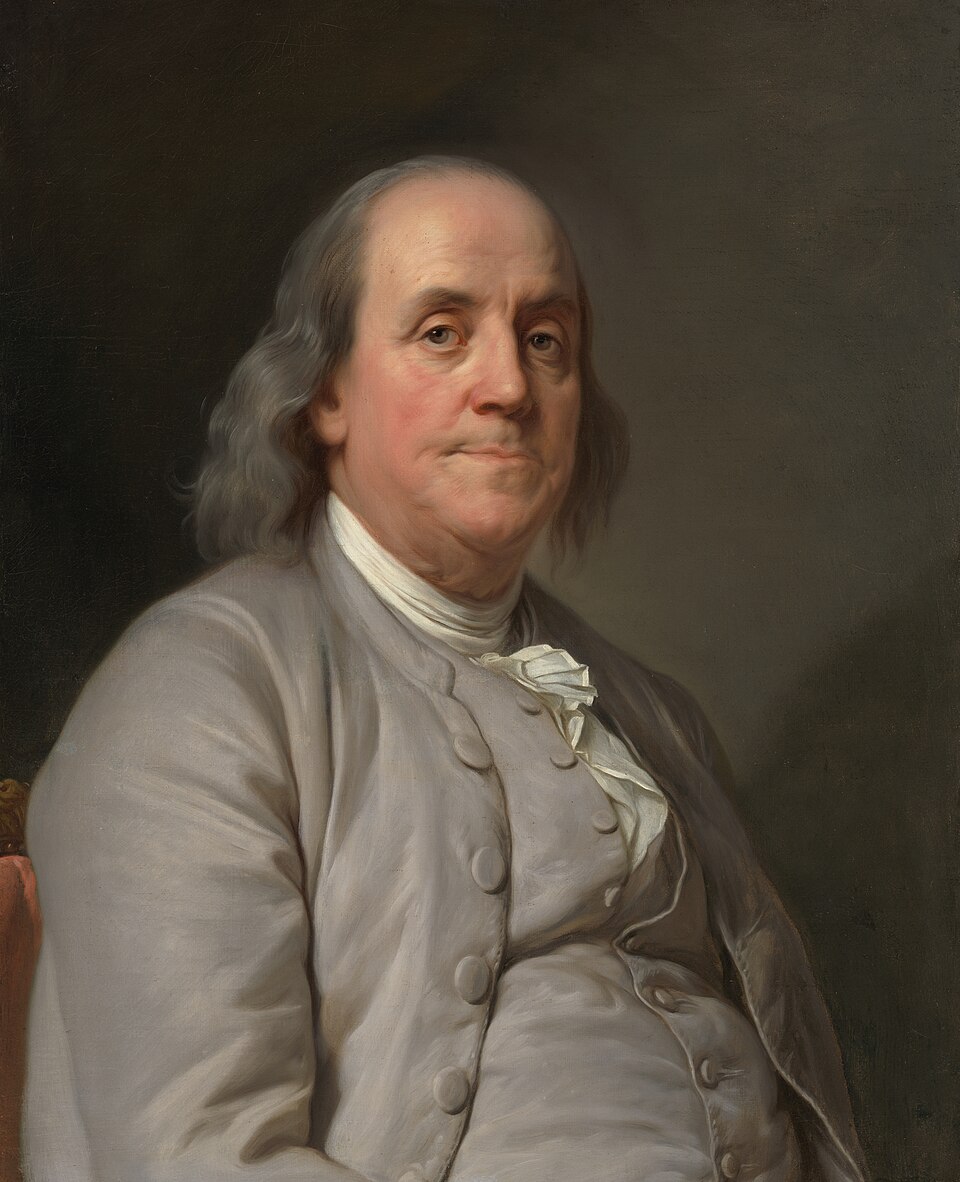
MathWorld says Franklin constructed this 8x8 semimagic square in 1750, with magic constant 260. Semimagic means a square whose rows and columns share one sum, with no requirement on the long diagonals. In Franklin's square they miss. In his Autobiography, Franklin says the Assembly debates he had to sit through as clerk, in which he could take no part, were "so unentertaining that I was induc'd to amuse myself with making magic squares or circles". The passage is about his magic squares in general, not this grid specifically.
The grid and its total
Like the squares in the 3x3 and 4x4 guides, it is a normal square: each whole number from 1 to 64 appears exactly once. The magic constant formula gives the sum that each row of an 8x8 square must reach, 8(64 + 1) / 2 = 260 Franklin's rows and columns all land on that number. The grid is transcribed from MathPages, and every row and column total was recomputed for this page.
Highlight a pattern
| 52 | 61 | 4 | 13 | 20 | 29 | 36 | 45 |
| 14 | 3 | 62 | 51 | 46 | 35 | 30 | 19 |
| 53 | 60 | 5 | 12 | 21 | 28 | 37 | 44 |
| 11 | 6 | 59 | 54 | 43 | 38 | 27 | 22 |
| 55 | 58 | 7 | 10 | 23 | 26 | 39 | 42 |
| 9 | 8 | 57 | 56 | 41 | 40 | 25 | 24 |
| 50 | 63 | 2 | 15 | 18 | 31 | 34 | 47 |
| 16 | 1 | 64 | 49 | 48 | 33 | 32 | 17 |
No pattern selected. Highlighted cells are shown in bold with a heavy outline and a tinted background.
| Pattern | Example, added up | Checked across | Result | Highlight |
|---|---|---|---|---|
| Row 1 | 52 + 61 + 4 + 13 + 20 + 29 + 36 + 45 = 260 | all 8 rows | Adds to 260 | |
| Column 1 | 52 + 14 + 53 + 11 + 55 + 9 + 50 + 16 = 260 | all 8 columns | Adds to 260 | |
| Left half of row 1 | 52 + 61 + 4 + 13 = 130 | all 16 half-rows | Adds to 130 | |
| Top half of column 1 | 52 + 14 + 53 + 11 = 130 | all 16 half-columns | Adds to 130 | |
| Bent diagonal from the top left | 52 + 3 + 5 + 54 + 10 + 57 + 63 + 16 = 260 | all 8 starting positions in this orientation (5 inside the grid, 3 wrapping); the other orientations also work | Adds to 260 | |
| Bent diagonal that wraps round the edge | 29 + 30 + 44 + 11 + 55 + 24 + 34 + 33 = 260 | all 8 positions, wrapping included | Adds to 260 | |
| 2x2 block, top left | 52 + 61 + 14 + 3 = 130 | all 49 blocks inside the grid | Adds to 130 | |
| 2x2 block that wraps round the edge | 17 + 16 + 45 + 52 = 130 | all 64 blocks, wrapping included | Adds to 130 | |
| Four corners plus the four middle cells | 52 + 45 + 16 + 17 + 54 + 43 + 10 + 23 = 260 | one set | Adds to 260 | |
| Main diagonal, top left to bottom right | 52 + 3 + 5 + 54 + 23 + 40 + 34 + 17 = 228 | one line | Does not add to 260 | |
| Other main diagonal, top right to bottom left | 45 + 30 + 28 + 43 + 10 + 57 + 63 + 16 = 292 | one line | Does not add to 260 |
What the patterns tell you
- Half-rows, half-columns and 2x2 blocks add to 130, half the constant. MathWorld states: "Any half-row or half-column in this square totals 130." The Wichita State page on the square says: "The four entries in every 2x2 subsquare sum to 130." A grid where every half-row adds to 130 has rows that add to 260 automatically, so the 2x2 blocks and bent diagonals are the extra conditions.
- Bent diagonals. Start in the top row and step diagonally down and across for four cells, then step back toward the same edge for four more. 52-3-5-54-10-57-63-16 is MathWorld's example. The same chevron works pointing left or right, and turned on its side so it runs across the grid. All of these add to 260, including the ones that wrap round an edge. MathPages notes that Franklin's description does not say whether wrapped paths count; on this grid they do.
- Wrapping means that a pattern running off one edge continues from the opposite edge. Wrapped 2x2 blocks pass too.
- Corners and centre. The four corners and the four middle cells together add to 260, as MathWorld notes.
The patterns that do not hold
The two long diagonals fail. The main diagonal adds to 228 and the other to 292, so neither reaches 260. MathPages makes the same point about Franklin's squares: "neither of Franklin's squares satisfies the main diagonal sums". Under the usual definition, which asks for the diagonals to match, the square therefore falls short. Dürer's square, by contrast, is fully magic, with both diagonals correct.