History of magic squares: from the Lo Shu to today
Magic squares are old enough that their beginnings are mixed up with legend. This page is a short timeline from the Chinese Lo Shu to a prize problem that is still open, with dates taken from Wikipedia and MathWorld.
A magic square is a grid of numbers in which every row, column and diagonal adds to the same total. If that is new to you, start with the 3x3 magic square guide, which explains the smallest case. Where a date is only a legend, it is labelled that way.
The timeline at a glance
The Lo Shu: legend and square
The Lo Shu begins as a story. Wikipedia’s magic square article says legends of the Lo Shu, a name usually rendered as the scroll of the river Lo, date from as early as 650 BCE. Treat that as a legend: the story is old, but it is not a dated record of a square.
The square itself is the order-3 grid 4 9 2 / 3 5 7 / 8 1 6, with every row, column and diagonal adding to 15. MathWorld says the unique normal square of order three was known to the ancient Chinese, who called it the Lo Shu. Wikipedia adds that the first unequivocal instance of the square appears in the Mingtang (Bright Hall) chapter of a book from the 1st century, the Da Dai Liji. The China section of that article cites Yoke and Cammann among its sources. You can see why this is the only arrangement, apart from rotations and reflections, in the 3x3 guide.
You may see 190 BCE given for the square. Wikipedia’s introduction states it but flags it as needing a citation, so we rely on the 1st-century Da Dai Liji as the earliest unequivocal instance.
Arabic treatises, 9th to 10th century
The Wikipedia section on the Middle East and North Africa says treatises on magic squares were written in the 9th century, and that the earliest surviving ones date from the 10th century. It adds that the first dateable appearance of an order-3 square, within that tradition, occurs in a work by Jābir ibn Ḥayyān, where the square is linked to alchemy.
Khajuraho, 12th century
In India, a well-known 12th-century 4×4 square is inscribed on the wall of the Parshvanath temple at Khajuraho, according to Wikipedia. It is known as the Chautisa Yantra, because its magic sum is 34.
Yang Hui, 1275
For squares bigger than 3x3 in China, the Wikipedia China section names Yang Hui’s Xugu zheqi suanfa, written in 1275, as the oldest surviving Chinese treatise that displays them.
Moschopoulos, about 1315
Around 1315, Wikipedia says, the Byzantine Greek scholar Manuel Moschopoulos, influenced by Arab sources, wrote a mathematical treatise on the subject.
Dürer, 1514
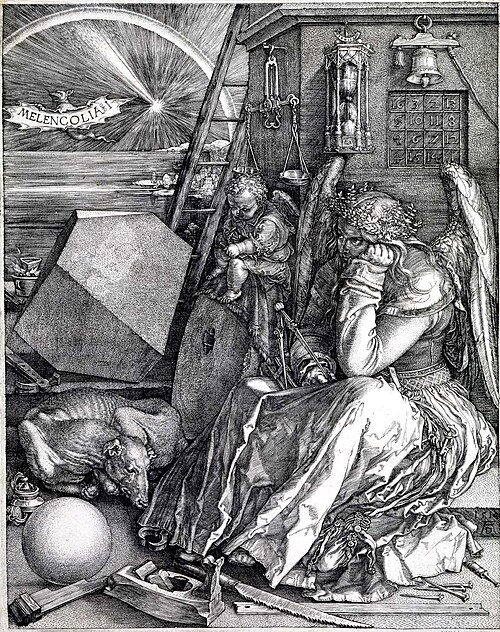
In 1514 Albrecht Dürer put a 4×4 square into his engraving Melencolia I, which Wikipedia says is believed to be the first magic square seen in European art. The picture above is that engraving; the square is the grid at upper right. For how its numbers are arranged, see our page on Dürer’s magic square.
Agrippa, 1531 and 1533
Cornelius Agrippa published his De occulta philosophia in 1531, according to Wikipedia, which says he devoted a chapter of Book II to planetary squares. The Wikipedia article on the work says the first book was printed in 1531 and the full three volumes first appeared in Cologne in 1533.
De la Loubère, 1691
In 1691, Simon de la Loubère described the Indian continuous method for building odd-order squares, according to Wikipedia. MathWorld words it more carefully, saying the method is purported to have been first reported in the West by him. We walk through building odd-order squares in how to make a magic square.
Frénicle de Bessy, 1693
MathWorld states that Frénicle de Bessy enumerated the 880 squares of order four in 1693. Wikipedia likewise credits him with showing that exactly 880 distinct magic squares of order four exist. That count treats a square and its rotations and reflections as one.
Squares of squares, 1984 to today
The modern question is whether a 3×3 magic square can be built from nine different square numbers. Wikipedia’s article on magic squares of squares says the problem was first posed by Martin LaBar in the January 1984 College Mathematics Journal, and that Martin Gardner offered a prize of US$100 in 1996. The same article says brute-force searches have not found a solution and lists the problem as open. Our page on the magic square of squares covers the near misses.
Where to go next
For a report, start with the footnotes of Wikipedia’s magic square article. Two scholarly works it cites are Schuyler Cammann’s article on the evolution of magic squares in China and Ho Peng Yoke’s study of magic squares in China. The same article has a section on the Sagrada Família magic square. To try the squares yourself, use the magic square generator.