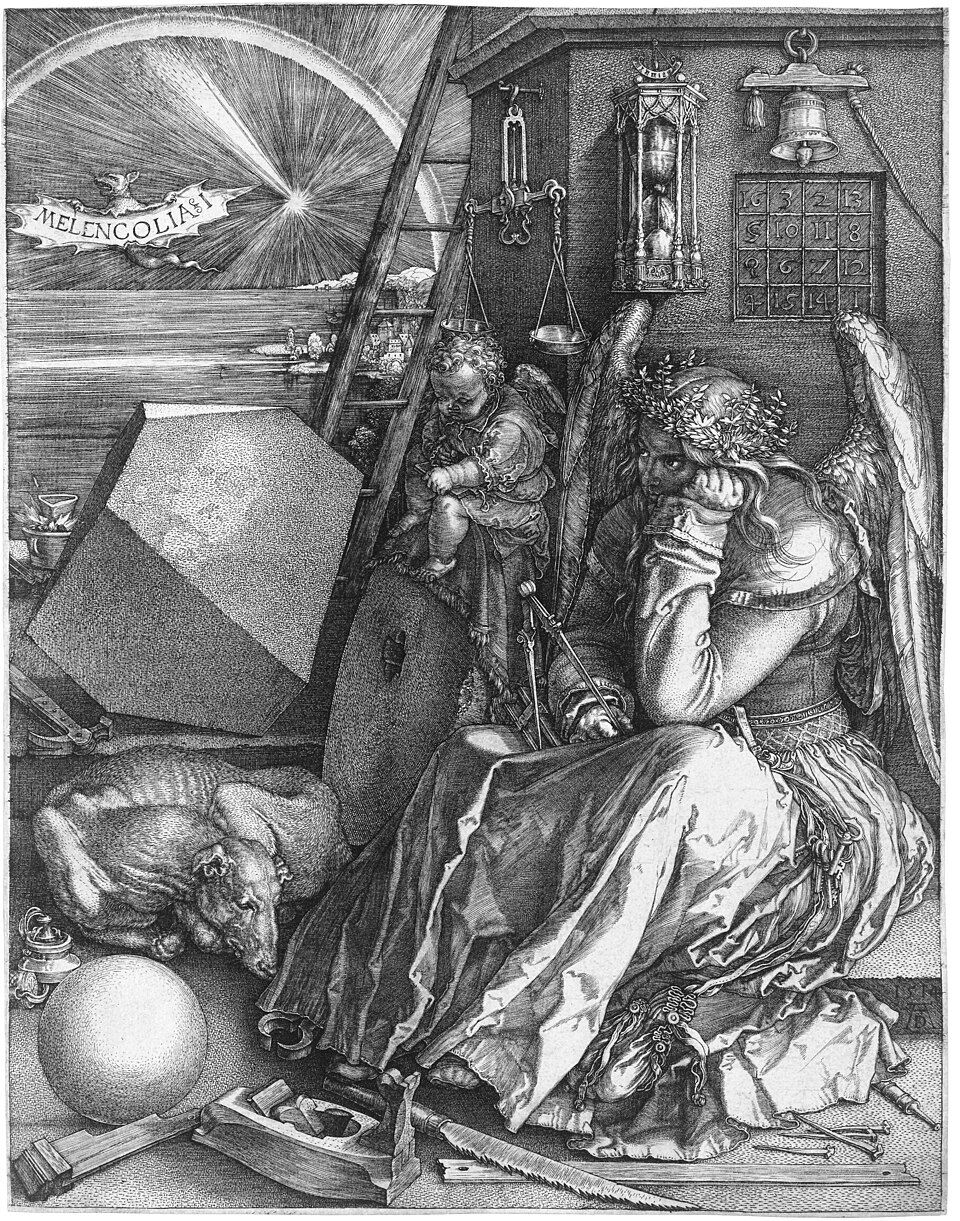
Dürer's magic square from Melencolia I
Albrecht Dürer put a 4x4 magic square in the top right corner of his 1514 engraving Melencolia I. Every row, column and diagonal adds to 34, and the two middle cells of the bottom row, 15 and 14, give the year of the engraving.
| 16 | 3 | 2 | 13 |
| 5 | 10 | 11 | 8 |
| 9 | 6 | 7 | 12 |
| 4 | 15 | 14 | 1 |
That is a normal magic square of order 4: it uses each whole number from 1 to 16 once. Wikipedia says that "As with every order 4 normal magic square, the magic sum is 34.", and the magic constant formula shows where that number comes from. Dürer's square is therefore one of many 4x4 magic squares. What sets it apart is where it appears and how many extra patterns it contains, which the highlighter below lets you see one at a time.
The square in the engraving
Melencolia I is, in Wikipedia's words, "a large 1514 engraving by the German Renaissance artist Albrecht Dürer". The square is on the wall of the building behind the seated figure, and Wikipedia calls it "the first printed in Europe". The same article describes "the two middle cells of the bottom row giving the date of the engraving, 1514", and MathWorld describes this version of the square as having "15 and 14 in adjacent middle columns in the bottom row".
The engraving does not explain the numbers. Wikipedia describes the square as "a talisman of Jupiter, an auspicious planet that fends off melancholy". Treat that as a reading of the picture, not as established fact.
Patterns that add to 34
Rows, columns and the two long diagonals are what the definition of a magic square asks for, which makes ten lines in all. Dürer's square also sums to 34 across its four corners, its centre and each quadrant, as Wikipedia notes. The table below lists 20 of the best-known groups, each re-added for this page. They are not the full set: Wikipedia's article on the square says it "has 86 sum combinations of the magic number 34". The rest are less regular shapes, such as the symmetric sets 2 + 8 + 9 + 15 and 3 + 5 + 12 + 14, which Wikipedia groups by shape. Choose Show on any row of the table and its cells light up in the grid, with the sum written out.
Highlight a pattern
| 16 | 3 | 2 | 13 |
| 5 | 10 | 11 | 8 |
| 9 | 6 | 7 | 12 |
| 4 | 15 | 14 | 1 |
No pattern selected. Highlighted cells are shown in bold with a heavy outline and a tinted background.
| Pattern | Type | Sum | Highlight |
|---|---|---|---|
| Row 1 | Rows | 16 + 3 + 2 + 13 = 34 | |
| Row 2 | Rows | 5 + 10 + 11 + 8 = 34 | |
| Row 3 | Rows | 9 + 6 + 7 + 12 = 34 | |
| Row 4 | Rows | 4 + 15 + 14 + 1 = 34 | |
| Column 1 | Columns | 16 + 5 + 9 + 4 = 34 | |
| Column 2 | Columns | 3 + 10 + 6 + 15 = 34 | |
| Column 3 | Columns | 2 + 11 + 7 + 14 = 34 | |
| Column 4 | Columns | 13 + 8 + 12 + 1 = 34 | |
| Main diagonal (top left to bottom right) | Diagonals | 16 + 10 + 7 + 1 = 34 | |
| Other diagonal (top right to bottom left) | Diagonals | 13 + 11 + 6 + 4 = 34 | |
| Four corners | Four corners | 16 + 13 + 4 + 1 = 34 | |
| Centre 2x2 block | Centre block | 10 + 11 + 6 + 7 = 34 | |
| Top left 2x2 block | Quadrants (2x2) | 16 + 3 + 5 + 10 = 34 | |
| Top right 2x2 block | Quadrants (2x2) | 2 + 13 + 11 + 8 = 34 | |
| Bottom left 2x2 block | Quadrants (2x2) | 9 + 6 + 4 + 15 = 34 | |
| Bottom right 2x2 block | Quadrants (2x2) | 7 + 12 + 14 + 1 = 34 | |
| Top left 3x3 block, its four corners | Corners of 3x3 blocks | 16 + 2 + 9 + 7 = 34 | |
| Top right 3x3 block, its four corners | Corners of 3x3 blocks | 3 + 13 + 6 + 12 = 34 | |
| Bottom left 3x3 block, its four corners | Corners of 3x3 blocks | 5 + 11 + 4 + 14 = 34 | |
| Bottom right 3x3 block, its four corners | Corners of 3x3 blocks | 10 + 8 + 15 + 1 = 34 |
The last four rows of the table are the corners of each 3x3 block inside the grid, a pattern Wikipedia also mentions. One more property is not in the table: any two cells opposite each other through the centre add to 17, for example 16 + 1, 3 + 14 and 10 + 7. These patterns are a consequence of the numbers 1 to 16 being placed in a particular symmetric way, not an extra rule Dürer had to meet. A magic square only has to satisfy the ten lines.
How it relates to the standard 4x4 construction
Dürer's square is close to the one you get from the complement method, described in the 4x4 magic square guide: write 1 to 16 in order, then replace each number on the two diagonals with its complement, 17 minus that number. That gives the square 16, 2, 3, 13 / 5, 11, 10, 8 / 9, 7, 6, 12 / 4, 14, 15, 1. Swap its second and third columns and you get Dürer's grid exactly: the top row 16, 2, 3, 13 becomes 16, 3, 2, 13, and the bottom row 4, 14, 15, 1 becomes 4, 15, 14, 1. Swapping the two middle columns leaves every row and column sum at 34. Here the diagonals also stay at 34 (16 + 10 + 7 + 1 and 13 + 11 + 6 + 4), but that is a property of this particular square, not of column swaps in general. This is a check made for this page, not something Dürer is known to have done, and the engraving does not say how he arrived at his arrangement.
The same guide gives the count of different 4x4 magic squares, so it is not repeated here. If you want to experiment with the pattern yourself, fill in a partly blank copy of this grid in the magic square solver, or read the how to make a magic square guide for other sizes. Dürer's square belongs to a much older tradition, told in the history of magic squares. For a plain definition and a generator, start from the home page.